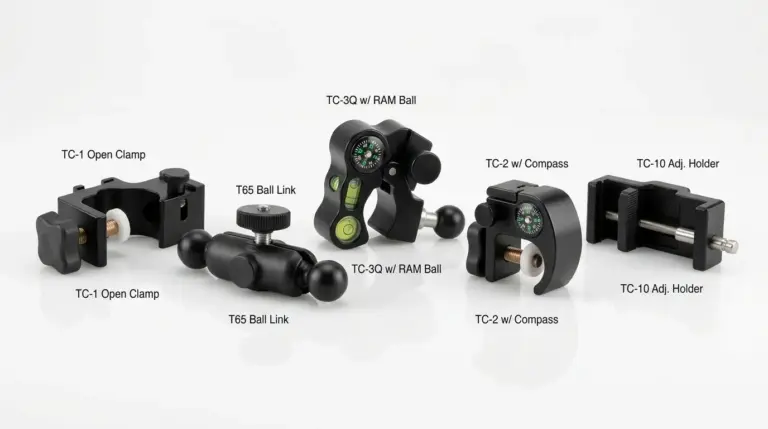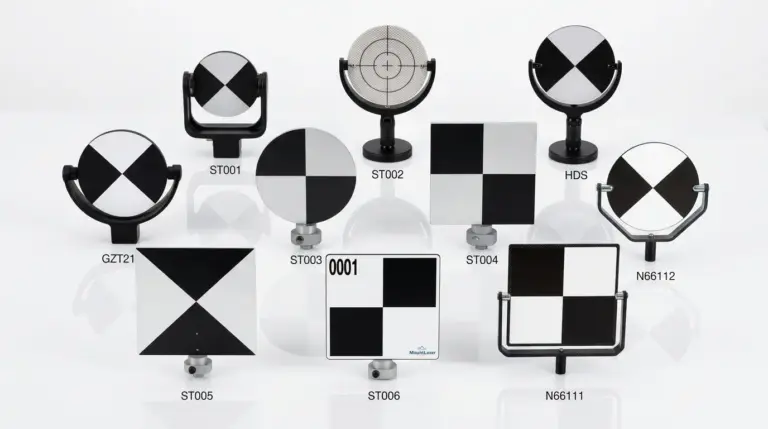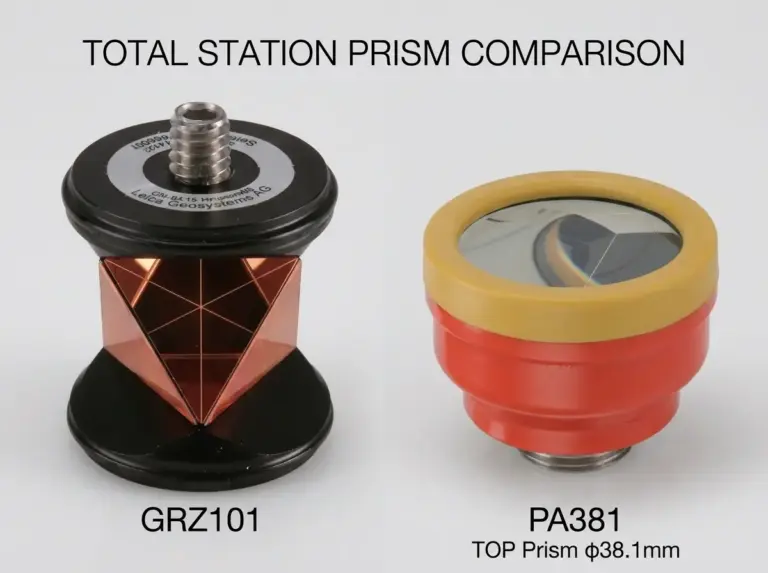














In the world of land surveying and construction, precision is paramount. Achieving millimeter-level accuracy over vast distances requires not only advanced instruments like Total Stations but also high-quality accessories to reflect their signals. This is where Surveying Prisms and Targets come into play.
At Mountlaser, we understand that the reliability of your measurements depends heavily on the quality of your optical reflectors. In this comprehensive guide, we will explore what survey prisms are, how they function, the different types available, and why choosing the right prism is critical for your surveying projects.
What Are Survey Prisms?
Survey prisms are specially designed retro-reflectors, or more precisely, corner reflectors. They are utilized to reflect the signal emitted from an Electronic Distance Measurement (EDM) device, such as a Total Station, back to its source. In the surveying industry, these prism assemblies are also commonly referred to as “targets”.
The primary function of a survey prism is to reflect the infrared beam emitted by a Total Station directly back to the instrument. This reflection allows the Total Station to calculate precise distances and angles based on the time it takes for the signal to return.
A high-quality prism in surveying applications is engineered to minimize the scatter of the EDM signal. By reducing signal dispersion, these prisms enable more accurate and longer-range electronic measurements.
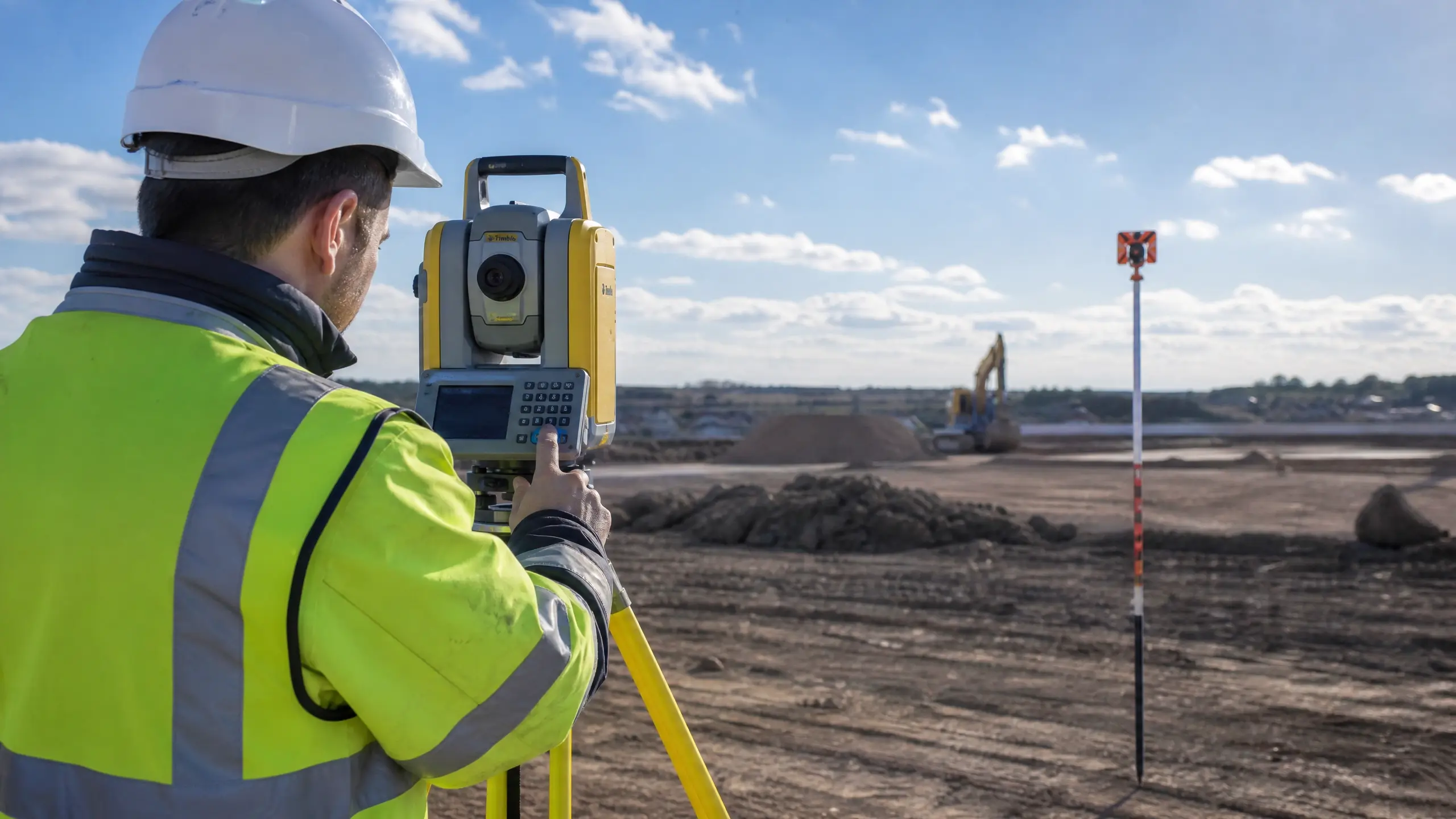
A professional surveyor operating a modern Total Station with a Mountlaser surveying prism in a construction site environment.
How Do Surveying Prisms Work?
The science behind surveying prisms relies on the principles of optics and retroreflection. A corner cube prism consists of three mutually perpendicular reflective surfaces. When a light beam enters the prism, it bounces off these three surfaces and is reflected back exactly parallel to its incoming path.
This unique property ensures that even if the prism is not perfectly aligned with the Total Station, the signal will still be returned accurately. However, the quality of the glass, the precision of the grinding, and the reflective coating applied to the prism surfaces significantly impact the strength and clarity of the returned signal.
Rigorous Optical Testing
To guarantee maximum signal return and measurement accuracy, every Mountlaser prism undergoes strict quality control. We test for prism constant accuracy, beam deviation, and surface flatness.
Watch our rigorous optical testing process below to see how we ensure every prism meets the highest industry standards:
Types of Survey Prisms
There is a large variety of optical reflectors used in surveying, each designed for specific applications, ranges, and environmental conditions. Most survey prisms fall under the following main categories:
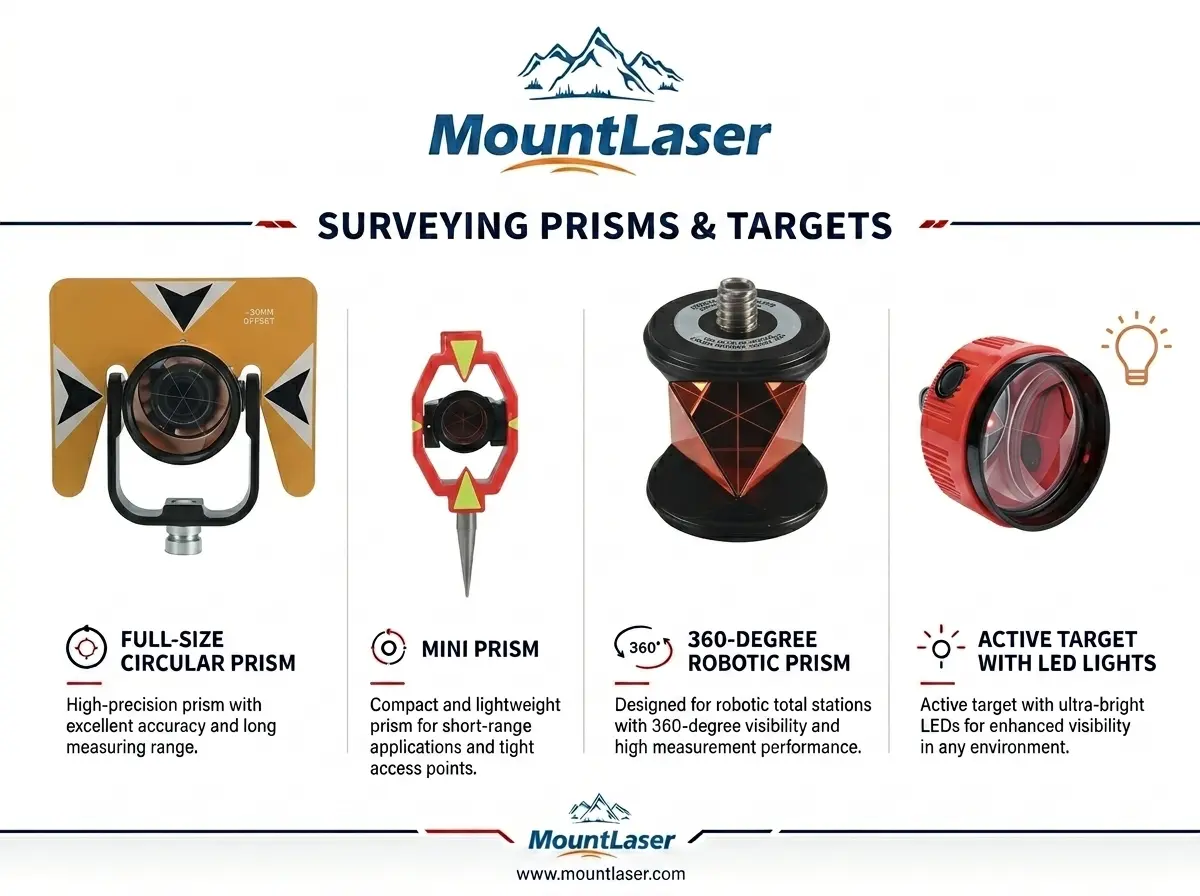
Mountlaser offers four main types of surveying prisms.
Prism Constants and Specifications
When selecting a survey prism, it is crucial to understand its specifications, particularly the prism constant. The prism constant is the physical offset between the optical center of the prism and its mechanical mounting point (the plumb line).
Total Stations must be programmed with the correct prism constant to calculate the true distance accurately. Using an incorrect prism constant will result in systematic errors in all distance measurements.
| Specification | Beschreibung | Typical Values |
|---|---|---|
| Prism Constant | Offset between optical center and mechanical mounting point | 0mm, -30mm, -34.4mm |
| Prism Height Offset | Vertical distance from mounting point to prism center | Varies by model |
| Centering Accuracy | Precision of alignment over a specific point | ±1-2mm |
| Measurement Range | Maximum distance for accurate signal return | 500m – 3000m+ |
Other important specifications include the prism height offset (the vertical distance from the mounting point to the center of the prism) and centering accuracy (the precision with which the prism can be aligned over a specific point).
The Mountlaser Advantage: Factory Manufacturing
At Mountlaser, we manufacture our own prisms with premium optical glass and advanced techniques.
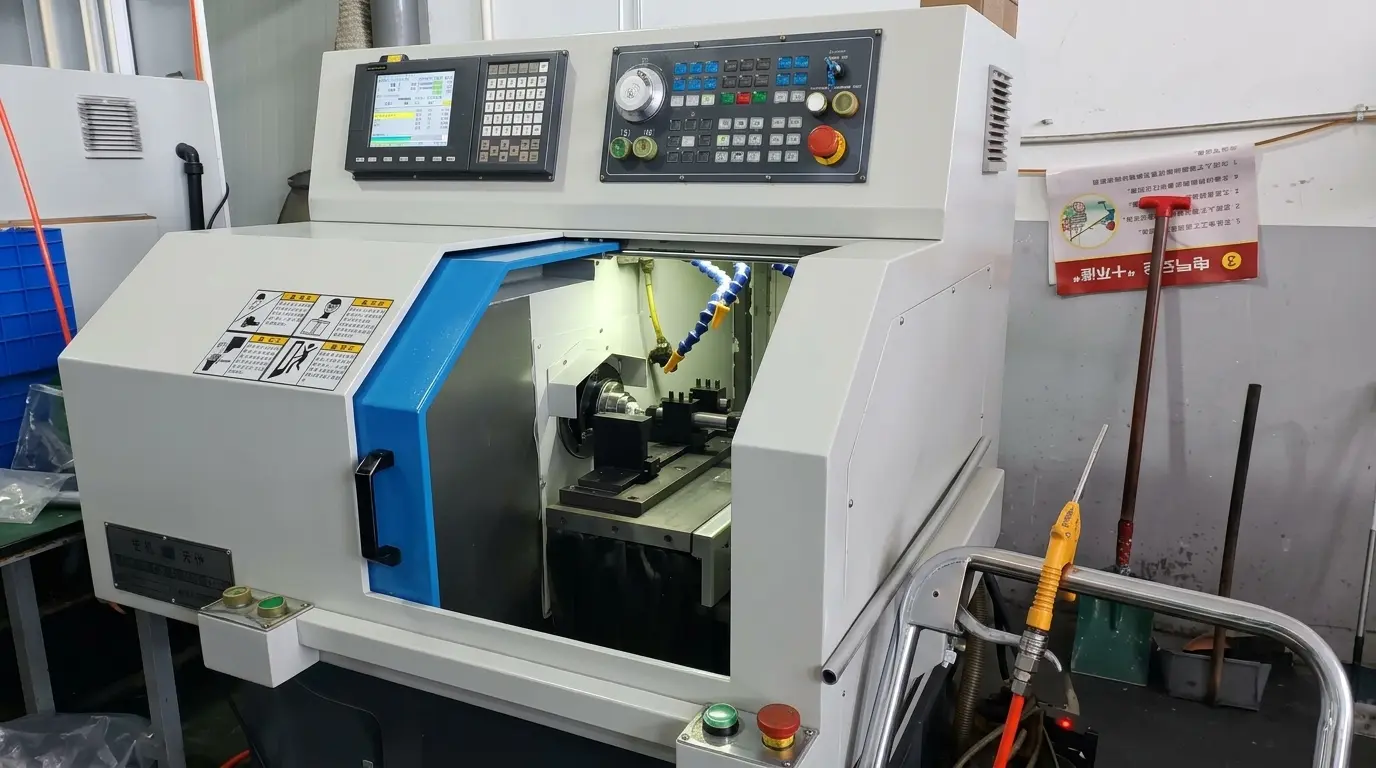
Precision manufacturing at Mountlaser factory.
Explore Mountlaser Surveying Products
References
Surveying Prisms and Targets
byu/geomatics_cc inVermessung